White Cement vs Grey Cement: What’s the Difference?

White Cement vs Grey Cement

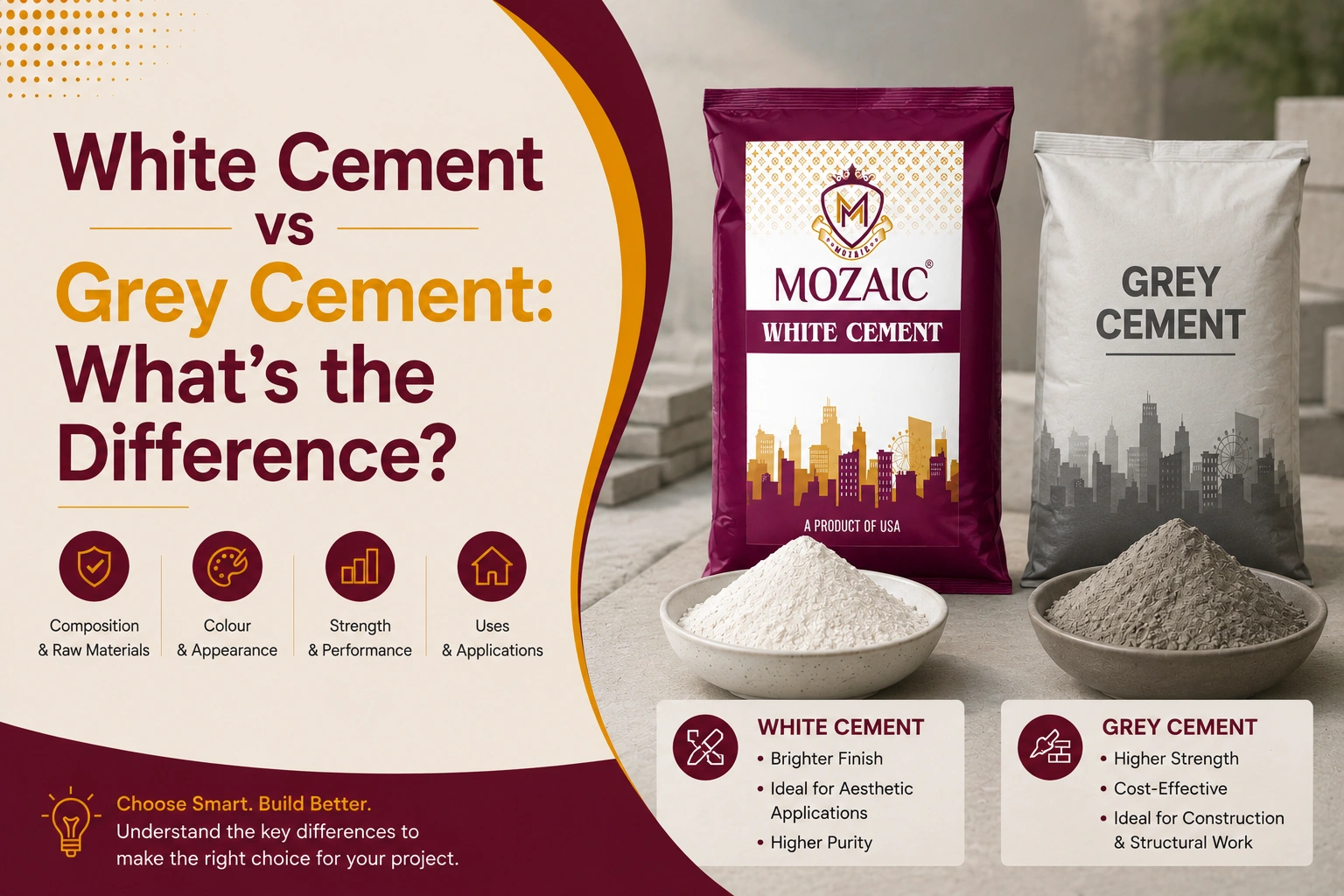
White cement and grey cement are both cementitious materials, but they differ in colour, composition, appearance, applications, and finishing requirements. Grey cement is widely used for structural and general construction, while white cement is preferred for decorative finishes, bright surfaces, terrazzo, selected tile applications, paints, and architectural work. The right choice depends on the project’s performance and aesthetic requirements.

What Is White Cement?

White cement is a finely ground cementitious material manufactured to achieve a significantly lighter colour than conventional grey cement. Its bright appearance makes it useful where the final finish, colour consistency, and visual appeal are important.

Mozaic Chemical’s white cement product is positioned for applications including paints, plasters, mosaic tiles, terrazzo flooring, and other white-cement-based products. The company highlights properties such as fineness, brightness, moisture resistance, and a smooth finish.

Because of its appearance, white cement is commonly selected for architectural and decorative applications where grey cement could affect the final colour.

What Is Grey Cement?

Grey cement is the conventional cement used extensively throughout residential, commercial, industrial, and infrastructure construction.

It is commonly associated with:

  • Concrete production
  • Structural work
  • Masonry
  • Plastering
  • Foundations
  • General construction
  • Cement-based finishing

Its widespread availability and established use make it the standard choice for many structural construction requirements.

White Cement vs Grey Cement: Key Differences

Understanding the difference between these two materials helps architects, contractors, and project managers select the appropriate product.

FeatureWhite CementGrey Cement
ColourBright whiteGrey
Main AdvantageAppearance and finishingGeneral construction
Decorative ApplicationsExcellentLimited
Colour ImpactMinimalStronger grey base
Architectural FinishesHighly suitableLess suitable
Common Construction UseFinishing & decorative workStructural & general work
Typical AppearanceSmooth and brightConventional cement finish

The most important difference is not simply colour. The appropriate cement should be selected according to the application’s technical requirements.

Why Is the Difference Important?

Choosing between white and grey cement can directly influence the appearance and performance of a finished surface.

For example, architects working with light-coloured decorative surfaces may prefer white cement because the lighter base can help achieve the intended visual result.

On the other hand, structural construction typically relies on grey cement systems designed and specified for the required structural application.

Therefore, colour, application, performance requirements, and project specifications should all be considered before selection.

Benefits of White Cement

White cement offers several advantages for decorative and finishing applications.

1. Bright Appearance

Its light colour provides a clean base for decorative finishes and light-coloured surfaces.

2. Smooth Finish

Fine particle characteristics can contribute to a refined surface finish when correctly applied.

3. Better Colour Control

White cement can be useful when pigments or decorative materials need a lighter base.

4. Architectural Applications

It is suitable for applications where visual appearance is an important part of the design.

5. Versatile Finishing Material

White cement can be used in selected paints, plasters, terrazzo, mosaic, and other finishing applications.

Benefits of Grey Cement

Grey cement remains the preferred material for a broad range of general construction applications.

Its advantages include:

  • Extensive availability
  • Familiar application methods
  • Suitability for concrete
  • Wide construction use
  • Established supply chain
  • Compatibility with many cement-based systems

For structural applications, the cement should always be selected according to project specifications and applicable standards rather than colour alone.

Where Is White Cement Used?

White cement is particularly useful where aesthetics and finishing quality are important.

Common applications include:

  • Decorative plaster
  • Architectural finishes
  • Terrazzo flooring
  • Mosaic applications
  • Selected tile-related work
  • Decorative concrete
  • Paint and coating formulations
  • Interior finishing

Mozaic Chemical specifically promotes its white cement for paints, plasters, mosaic tiles, terrazzo flooring, and related white-cement-based products.

Where Is Grey Cement Used?

Grey cement is widely used for:

  • Foundations
  • Columns
  • Beams
  • Slabs
  • Concrete structures
  • Masonry
  • General plastering
  • Infrastructure construction

For structural work, engineers and contractors should follow the specified cement grade and project requirements.

Can White Cement Replace Grey Cement?

Not always.

White cement and grey cement may both be cementitious materials, but they are not automatically interchangeable for every application.

A project’s structural, performance, aesthetic, and specification requirements determine which material should be used.

For example, white cement can be an excellent choice for decorative finishing, but a structural concrete application must use the cement system specified by the structural design and applicable standards.

This distinction is especially important for builders and contractors because substituting materials solely based on appearance or availability can affect project performance.

White Cement vs Grey Cement for Tile-Related Applications

Tile installation requires more than simply choosing a cement colour.

Modern tile projects often use dedicated tile adhesives because they are formulated for specific substrates, tile types, and installation conditions.

For example, Mozaic Chemical offers dedicated tile adhesive solutions for interior and exterior tile bonding rather than relying solely on conventional cement-based installation methods.

For tile joints, the appropriate grout should also be selected according to the application. Mozaic Chemical’s grout range is positioned as a solution for sealing tile joints and improving resistance to stains, moisture, and cracking.

Therefore, floor tile adhesive, grout, and other tile installation products should be selected as part of a complete system.

What About White Cement for Tile Joints?

White cement has traditionally been used in certain tile-joint applications, particularly where a white finish is desired.

However, modern tile installations increasingly use dedicated grout products because they can provide application-specific properties such as improved stain resistance, crack resistance, and moisture resistance.

Mozaic Chemical’s grout information explains that tile joint fillers are designed to seal gaps between tiles and offers epoxy-based solutions for demanding applications.

For premium installations, selecting the correct tile joint grout according to tile type, joint width, moisture exposure, and expected traffic is more important than choosing a grout based only on colour.

White Cement vs Grey Cement: Which One Should You Choose?

Use this simple decision guide:

Choose White Cement When:

  • Appearance is a major priority.
  • You need a bright finishing base.
  • You are working on decorative surfaces.
  • You need a light-coloured cementitious material.
  • The application involves suitable paints, plasters, terrazzo, or mosaic work.

Choose Grey Cement When:

  • The project involves general construction.
  • Concrete or structural work is required.
  • The project specification calls for grey cement.
  • Decorative colour is not the primary requirement.

Always check technical specifications before making a final selection.

Common Mistakes to Avoid

Choosing Cement Based Only on Colour

Colour should not be the only selection criterion. Application, performance, substrate, and project specifications matter.

Using White Cement for an Unspecified Structural Application

White cement should not automatically replace a specified structural cement system.

Assuming Cement and Tile Adhesive Are the Same

Dedicated tile adhesives are formulated for tile bonding and can provide properties that conventional cement-based methods may not offer.

Ignoring Grout Selection

The grout between tiles contributes to joint protection, aesthetics, and moisture resistance. It should be selected according to the installation environment.

Using the Wrong Cleaning Product

After installation, regular maintenance should use an appropriate best tile cleaner suited to the tile and grout system.

Mozaic Chemical: Complete Construction Chemical Solutions

Mozaic Chemical provides a broad portfolio of construction chemical and tile installation solutions, including tile adhesives, grouts, epoxy grouts, tile cleaners, white cement, admixtures, and waterproofing products.

This broad range allows builders, architects, contractors, and project managers to select complementary products for different stages of construction and tile installation.

For example, its admixture solutions are designed to improve flexibility, bond strength, water resistance, and crack resistance in suitable cementitious grout applications.

Mozaic Chemical’s Industry Presence

Mozaic Chemical is positioned as a major manufacturer and supplier of tile installation and construction chemical solutions in India.

The company describes itself as a trusted tile adhesive and grout manufacturer, with an extensive product portfolio serving residential and commercial projects. Its portfolio includes tile adhesives, grouts, epoxy grouts, tile cleaners, white cement, admixtures, and waterproofing solutions.

For customers comparing construction chemical solutions, this broad portfolio can simplify product selection and sourcing across different project requirements.

Expert Recommendation

For builders, architects, and contractors, the best approach is to select cement according to application rather than colour.

  • Use white cement where brightness and decorative finishing are important.
  • Use the specified grey cement system for general and structural construction.
  • Use dedicated tile adhesives for demanding tile installations.
  • Select grout according to moisture, traffic, chemical exposure, and joint requirements.
  • Follow manufacturer instructions for mixing and application.
  • Use compatible cleaning products for finished surfaces.

For tile installation projects, combining the correct adhesive, grout, and maintenance products can provide better long-term performance than relying on cement alone.

Summary: White Cement vs Grey Cement

The key difference between white cement and grey cement is their colour and typical application profile, but the choice should go beyond appearance.

White cement is generally preferred for decorative, architectural, and light-coloured finishing applications. Grey cement is widely used for general and structural construction.

Neither material is universally better. The correct choice depends on the project’s technical specifications, desired finish, substrate, environmental conditions, and intended use.

For tile installation, dedicated adhesives and grout systems should also be considered to achieve reliable bonding and durable joints.

Frequently Asked Questions

1. What is the main difference between white cement and grey cement?

The most visible difference is colour. White cement is manufactured to provide a bright appearance and is commonly used for decorative and finishing applications, while grey cement is widely used for general construction and structural work.

2. Is white cement stronger than grey cement?

Strength depends on the specific cement formulation, grade, and application. White cement should not be considered stronger or weaker solely because of its colour.

3. Can white cement replace grey cement?

Not for every application. Structural and general construction should follow the cement type and grade specified for the project.

4. What is white cement commonly used for?

White cement is commonly used for decorative finishes, paints, plasters, terrazzo, mosaic applications, and other projects where a bright finish is desirable.

5. Can white cement be used for tiles?

White cement can be used in selected tile-related applications, but dedicated tile adhesives are generally preferable when the project requires specialized bonding performance.

6. Which is better for decorative work: white or grey cement?

White cement is generally preferred when a bright, clean, or light-coloured decorative finish is required.

7. Is white cement suitable for grout?

White cement can be used in some traditional joint-filling applications, but dedicated grout products can provide application-specific properties such as improved stain, moisture, and crack resistance.

8. Should I use tile adhesive instead of cement for tile installation?

For modern tile installations, a suitable tile adhesive can provide specialized bonding performance. The correct product should be selected according to the tile type, substrate, size, and installation conditions.

Contact Mozaic Chemical

Looking for white cement, tile adhesive, grout, epoxy grout, or tile-cleaning solutions?

Call Us: +91 9713200009
WhatsApp Us: +919588704408
Email Us: Info@mozaicchemical.com
Product Details
GENERAL ENQUIRY
contact us form
Social Links

White Cement vs Grey Cement: What’s the Difference?

Table of Contents

White cement and grey cement are both cementitious materials, but they differ in colour, composition, appearance, applications, and finishing requirements. Grey cement is widely used for structural and general construction, while white cement is preferred for decorative finishes, bright surfaces, terrazzo, selected tile applications, paints, and architectural work. The right choice depends on the project’s performance and aesthetic requirements.

What Is White Cement?

White cement is a finely ground cementitious material manufactured to achieve a significantly lighter colour than conventional grey cement. Its bright appearance makes it useful where the final finish, colour consistency, and visual appeal are important.

Mozaic Chemical’s white cement product is positioned for applications including paints, plasters, mosaic tiles, terrazzo flooring, and other white-cement-based products. The company highlights properties such as fineness, brightness, moisture resistance, and a smooth finish.

Because of its appearance, white cement is commonly selected for architectural and decorative applications where grey cement could affect the final colour.

What Is Grey Cement?

Grey cement is the conventional cement used extensively throughout residential, commercial, industrial, and infrastructure construction.

It is commonly associated with:

  • Concrete production
  • Structural work
  • Masonry
  • Plastering
  • Foundations
  • General construction
  • Cement-based finishing

Its widespread availability and established use make it the standard choice for many structural construction requirements.

White Cement vs Grey Cement: Key Differences

Understanding the difference between these two materials helps architects, contractors, and project managers select the appropriate product.

FeatureWhite CementGrey Cement
ColourBright whiteGrey
Main AdvantageAppearance and finishingGeneral construction
Decorative ApplicationsExcellentLimited
Colour ImpactMinimalStronger grey base
Architectural FinishesHighly suitableLess suitable
Common Construction UseFinishing & decorative workStructural & general work
Typical AppearanceSmooth and brightConventional cement finish

The most important difference is not simply colour. The appropriate cement should be selected according to the application’s technical requirements.

Why Is the Difference Important?

Choosing between white and grey cement can directly influence the appearance and performance of a finished surface.

For example, architects working with light-coloured decorative surfaces may prefer white cement because the lighter base can help achieve the intended visual result.

On the other hand, structural construction typically relies on grey cement systems designed and specified for the required structural application.

Therefore, colour, application, performance requirements, and project specifications should all be considered before selection.

Benefits of White Cement

White cement offers several advantages for decorative and finishing applications.

1. Bright Appearance

Its light colour provides a clean base for decorative finishes and light-coloured surfaces.

2. Smooth Finish

Fine particle characteristics can contribute to a refined surface finish when correctly applied.

3. Better Colour Control

White cement can be useful when pigments or decorative materials need a lighter base.

4. Architectural Applications

It is suitable for applications where visual appearance is an important part of the design.

5. Versatile Finishing Material

White cement can be used in selected paints, plasters, terrazzo, mosaic, and other finishing applications.

Benefits of Grey Cement

Grey cement remains the preferred material for a broad range of general construction applications.

Its advantages include:

  • Extensive availability
  • Familiar application methods
  • Suitability for concrete
  • Wide construction use
  • Established supply chain
  • Compatibility with many cement-based systems

For structural applications, the cement should always be selected according to project specifications and applicable standards rather than colour alone.

Where Is White Cement Used?

White cement is particularly useful where aesthetics and finishing quality are important.

Common applications include:

  • Decorative plaster
  • Architectural finishes
  • Terrazzo flooring
  • Mosaic applications
  • Selected tile-related work
  • Decorative concrete
  • Paint and coating formulations
  • Interior finishing

Mozaic Chemical specifically promotes its white cement for paints, plasters, mosaic tiles, terrazzo flooring, and related white-cement-based products.

Where Is Grey Cement Used?

Grey cement is widely used for:

  • Foundations
  • Columns
  • Beams
  • Slabs
  • Concrete structures
  • Masonry
  • General plastering
  • Infrastructure construction

For structural work, engineers and contractors should follow the specified cement grade and project requirements.

Can White Cement Replace Grey Cement?

Not always.

White cement and grey cement may both be cementitious materials, but they are not automatically interchangeable for every application.

A project’s structural, performance, aesthetic, and specification requirements determine which material should be used.

For example, white cement can be an excellent choice for decorative finishing, but a structural concrete application must use the cement system specified by the structural design and applicable standards.

This distinction is especially important for builders and contractors because substituting materials solely based on appearance or availability can affect project performance.

White Cement vs Grey Cement for Tile-Related Applications

Tile installation requires more than simply choosing a cement colour.

Modern tile projects often use dedicated tile adhesives because they are formulated for specific substrates, tile types, and installation conditions.

For example, Mozaic Chemical offers dedicated tile adhesive solutions for interior and exterior tile bonding rather than relying solely on conventional cement-based installation methods.

For tile joints, the appropriate grout should also be selected according to the application. Mozaic Chemical’s grout range is positioned as a solution for sealing tile joints and improving resistance to stains, moisture, and cracking.

Therefore, floor tile adhesive, grout, and other tile installation products should be selected as part of a complete system.

What About White Cement for Tile Joints?

White cement has traditionally been used in certain tile-joint applications, particularly where a white finish is desired.

However, modern tile installations increasingly use dedicated grout products because they can provide application-specific properties such as improved stain resistance, crack resistance, and moisture resistance.

Mozaic Chemical’s grout information explains that tile joint fillers are designed to seal gaps between tiles and offers epoxy-based solutions for demanding applications.

For premium installations, selecting the correct tile joint grout according to tile type, joint width, moisture exposure, and expected traffic is more important than choosing a grout based only on colour.

White Cement vs Grey Cement: Which One Should You Choose?

Use this simple decision guide:

Choose White Cement When:

  • Appearance is a major priority.
  • You need a bright finishing base.
  • You are working on decorative surfaces.
  • You need a light-coloured cementitious material.
  • The application involves suitable paints, plasters, terrazzo, or mosaic work.

Choose Grey Cement When:

  • The project involves general construction.
  • Concrete or structural work is required.
  • The project specification calls for grey cement.
  • Decorative colour is not the primary requirement.

Always check technical specifications before making a final selection.

Common Mistakes to Avoid

Choosing Cement Based Only on Colour

Colour should not be the only selection criterion. Application, performance, substrate, and project specifications matter.

Using White Cement for an Unspecified Structural Application

White cement should not automatically replace a specified structural cement system.

Assuming Cement and Tile Adhesive Are the Same

Dedicated tile adhesives are formulated for tile bonding and can provide properties that conventional cement-based methods may not offer.

Ignoring Grout Selection

The grout between tiles contributes to joint protection, aesthetics, and moisture resistance. It should be selected according to the installation environment.

Using the Wrong Cleaning Product

After installation, regular maintenance should use an appropriate best tile cleaner suited to the tile and grout system.

Mozaic Chemical: Complete Construction Chemical Solutions

Mozaic Chemical provides a broad portfolio of construction chemical and tile installation solutions, including tile adhesives, grouts, epoxy grouts, tile cleaners, white cement, admixtures, and waterproofing products.

This broad range allows builders, architects, contractors, and project managers to select complementary products for different stages of construction and tile installation.

For example, its admixture solutions are designed to improve flexibility, bond strength, water resistance, and crack resistance in suitable cementitious grout applications.

Mozaic Chemical’s Industry Presence

Mozaic Chemical is positioned as a major manufacturer and supplier of tile installation and construction chemical solutions in India.

The company describes itself as a trusted tile adhesive and grout manufacturer, with an extensive product portfolio serving residential and commercial projects. Its portfolio includes tile adhesives, grouts, epoxy grouts, tile cleaners, white cement, admixtures, and waterproofing solutions.

For customers comparing construction chemical solutions, this broad portfolio can simplify product selection and sourcing across different project requirements.

Expert Recommendation

For builders, architects, and contractors, the best approach is to select cement according to application rather than colour.

  • Use white cement where brightness and decorative finishing are important.
  • Use the specified grey cement system for general and structural construction.
  • Use dedicated tile adhesives for demanding tile installations.
  • Select grout according to moisture, traffic, chemical exposure, and joint requirements.
  • Follow manufacturer instructions for mixing and application.
  • Use compatible cleaning products for finished surfaces.

For tile installation projects, combining the correct adhesive, grout, and maintenance products can provide better long-term performance than relying on cement alone.

Summary: White Cement vs Grey Cement

The key difference between white cement and grey cement is their colour and typical application profile, but the choice should go beyond appearance.

White cement is generally preferred for decorative, architectural, and light-coloured finishing applications. Grey cement is widely used for general and structural construction.

Neither material is universally better. The correct choice depends on the project’s technical specifications, desired finish, substrate, environmental conditions, and intended use.

For tile installation, dedicated adhesives and grout systems should also be considered to achieve reliable bonding and durable joints.

Frequently Asked Questions

1. What is the main difference between white cement and grey cement?

The most visible difference is colour. White cement is manufactured to provide a bright appearance and is commonly used for decorative and finishing applications, while grey cement is widely used for general construction and structural work.

2. Is white cement stronger than grey cement?

Strength depends on the specific cement formulation, grade, and application. White cement should not be considered stronger or weaker solely because of its colour.

3. Can white cement replace grey cement?

Not for every application. Structural and general construction should follow the cement type and grade specified for the project.

4. What is white cement commonly used for?

White cement is commonly used for decorative finishes, paints, plasters, terrazzo, mosaic applications, and other projects where a bright finish is desirable.

5. Can white cement be used for tiles?

White cement can be used in selected tile-related applications, but dedicated tile adhesives are generally preferable when the project requires specialized bonding performance.

6. Which is better for decorative work: white or grey cement?

White cement is generally preferred when a bright, clean, or light-coloured decorative finish is required.

7. Is white cement suitable for grout?

White cement can be used in some traditional joint-filling applications, but dedicated grout products can provide application-specific properties such as improved stain, moisture, and crack resistance.

8. Should I use tile adhesive instead of cement for tile installation?

For modern tile installations, a suitable tile adhesive can provide specialized bonding performance. The correct product should be selected according to the tile type, substrate, size, and installation conditions.

Contact Mozaic Chemical

Looking for white cement, tile adhesive, grout, epoxy grout, or tile-cleaning solutions?

Call Us: +91 9713200009
WhatsApp Us: +919588704408
Email Us: Info@mozaicchemical.com

Blogs