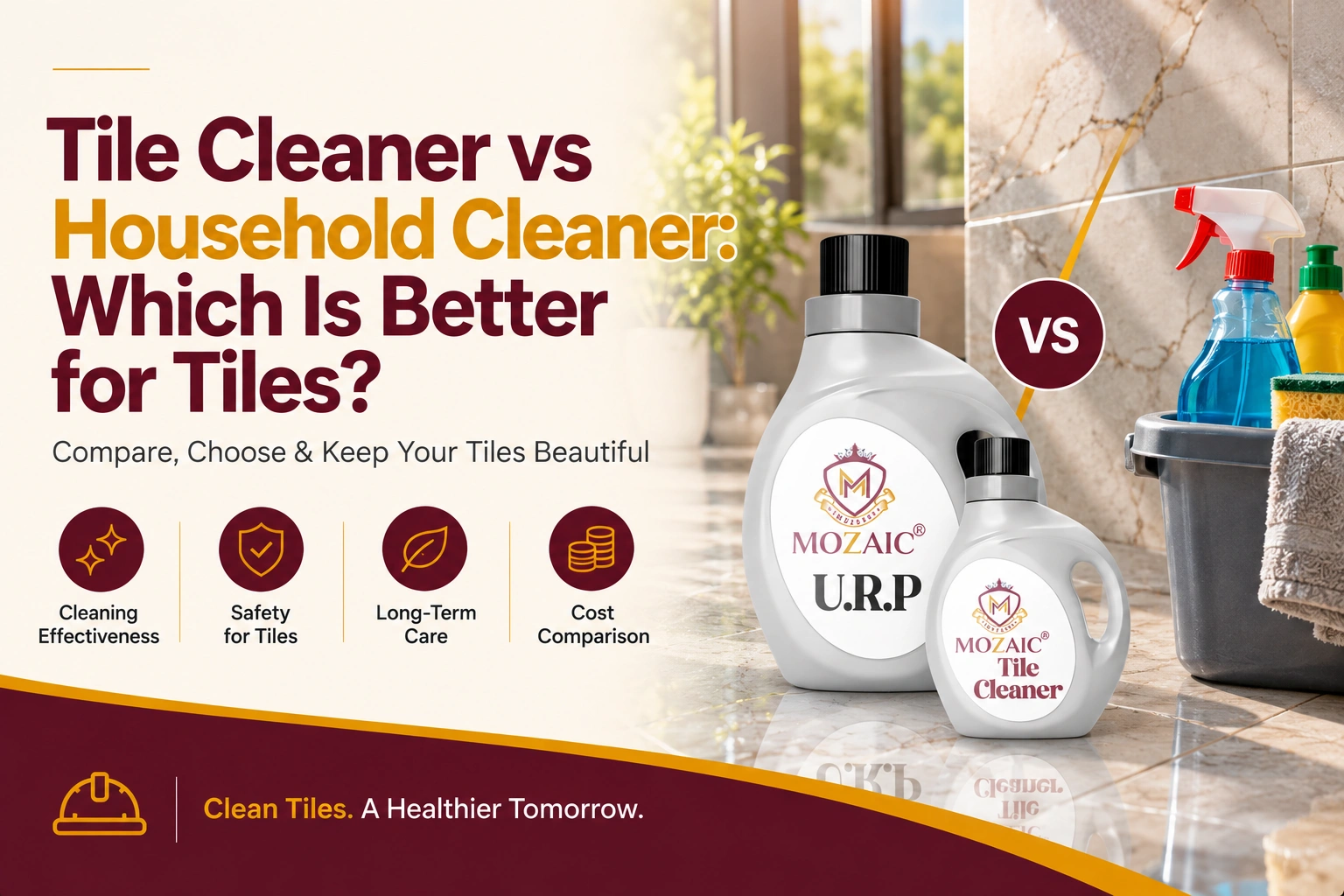
When comparing tile cleaner vs household cleaner, the better choice depends on the surface, type of dirt, and cleaning requirement. Household cleaners are designed for general surfaces, while tile cleaners are formulated specifically for tiled surfaces and grout. For tough stains, residue and regular tile maintenance, a suitable tile cleaner can provide more targeted cleaning with better surface compatibility.
What Is the Difference Between a Tile Cleaner and a Household Cleaner?
A tile cleaner is formulated specifically for tiled surfaces such as ceramic, porcelain, vitrified tiles, stone and related grout surfaces. It is designed to deal with common tile problems including dirt, stains, soap deposits, grease and installation residue.
A household cleaner is a general-purpose cleaning product intended for multiple surfaces. Depending on its formulation, it may be suitable for countertops, glass, furniture, appliances or other household areas, but that does not automatically make it appropriate for every type of tile or grout.
This distinction becomes particularly important when cleaning newly installed tiles, textured surfaces, bathrooms, kitchens and commercial flooring.
Tile Cleaner vs Household Cleaner: Key Differences
| Factor | Tile Cleaner | Household Cleaner |
|---|---|---|
| Primary purpose | Tile and grout cleaning | General household cleaning |
| Surface compatibility | Designed for specific tiled surfaces | Depends on product formulation |
| Tough tile residue | Generally more targeted | May have limited effectiveness |
| Grout cleaning | Can be designed for grout-compatible use | Not always suitable |
| Construction residue | Certain products can address stubborn residue | Usually not the primary purpose |
| Regular maintenance | Suitable when used according to instructions | Depends on formulation |
| Best use | Tiles, grout and related surfaces | General household surfaces |
The important point is not that every household cleaner is harmful to tiles. Rather, the formulation should match the surface and cleaning problem.
Why Is Choosing the Right Tile Cleaner Important?
Tiles may look simple to clean, but their surface finish and grout joints can react differently to cleaning chemicals. Choosing an unsuitable product or using excessive chemical concentration can leave residue, affect the appearance of the surface or create problems around grout joints.
A suitable tile cleaning solution can help with:
- Removing accumulated dirt and surface grime
- Tackling suitable types of stains and residue
- Maintaining the appearance of finished tiles
- Cleaning around grout joints
- Supporting regular maintenance
- Reducing the need for aggressive scrubbing
For large residential, commercial or infrastructure projects, selecting the appropriate cleaning chemical can also make routine maintenance more consistent.
When Should You Use a Tile Cleaner?
A dedicated cleaner becomes particularly useful when ordinary water and mild cleaning are not enough.
1. After Tile Installation
Newly installed tiles may have cement residue, grout haze or construction-related deposits. The appropriate cleaning product can help remove suitable residues after installation, provided the manufacturer’s instructions are followed.
It is also important to allow the tile adhesive and grout system to develop adequate strength before carrying out aggressive cleaning.
2. In Bathrooms and Kitchens
Bathrooms and kitchens regularly experience moisture, soap deposits, grease and dirt. These conditions can make routine cleaning more demanding.
A suitable tile cleaner can help maintain tiled surfaces while keeping grout joints easier to maintain.
3. In Commercial and High-Traffic Areas
Shopping centres, hotels, offices, hospitals and other commercial spaces can experience significantly higher levels of dirt and foot traffic than residential areas.
In these environments, consistent cleaning procedures are important for maintaining both appearance and hygiene.
What About Household Cleaners?
Household cleaners can still have a role in routine cleaning. A mild, surface-compatible cleaner may be appropriate for everyday dirt when the product label specifically permits use on the particular tile.
However, avoid assuming that a product designed for one surface is automatically suitable for another.
Before using a household cleaner on tiles, check:
- Recommended surfaces
- Chemical composition
- Manufacturer’s instructions
- Compatibility with grout
- Recommended dilution
- Whether it is suitable for natural stone or sensitive finishes
If you’re trying to remove tile stains, identifying the type of stain first is more effective than simply using a stronger chemical.
How to Choose the Right Cleaner for Tiles
Follow these steps before selecting a cleaning product.
Step 1: Identify the Tile Type
Determine whether the surface is ceramic, porcelain, vitrified, natural stone or another material.
Different surfaces can have different chemical sensitivities.
Step 2: Identify the Contamination
Determine whether you are dealing with:
- Everyday dirt
- Grease
- Soap deposits
- Hard-water deposits
- Cement residue
- Grout residue
- Organic staining
The cleaning requirement should determine the product.
Step 3: Check Grout Compatibility
Grout joints are an important part of any tiled installation. If the floor uses epoxy tile grout, for example, cleaning should follow the grout manufacturer’s recommendations.
Step 4: Follow the Correct Dilution
More chemical does not necessarily mean better cleaning. Excessive concentration can create unnecessary residue or surface problems.
For example, Mozaic Chemical provides specific usage guidance for its tile cleaner, including dilution instructions for routine cleaning.
Step 5: Test an Inconspicuous Area
Before treating a large area, test the cleaner on a small, less visible section. Check for changes in colour, finish or surface appearance.
What Role Does Grout Play in Tile Cleaning?
Cleaning should not focus only on the visible tile surface. The joints between tiles also collect dirt and contaminants.
Choosing appropriate grout for tiles can make long-term maintenance easier. In areas exposed to moisture, stains or chemicals, the grout specification should match the application’s demands.
For suitable applications, grouting with epoxy grout can provide a dense, stain-resistant joint system that is easier to maintain than some conventional grout systems. Mozaic Chemical describes its epoxy grout as stain-resistant, chemically resistant and suitable for demanding applications.
Common Mistakes to Avoid
Using Any Cleaner on Any Tile
Different tile and stone surfaces have different requirements. Always verify compatibility.
Using Too Much Chemical
Higher concentration is not automatically more effective. Follow the manufacturer’s recommended dilution.
Ignoring Grout Joints
Dirt can accumulate in joints even when the tile surface looks clean. Include grout in the regular maintenance routine.
Scrubbing Too Aggressively
Excessive mechanical scrubbing can affect delicate finishes. Start with the least aggressive suitable cleaning method.
Mixing Cleaning Chemicals
Never mix different cleaning chemicals unless the manufacturers specifically state that they are compatible. Unexpected chemical reactions can create safety and surface-damage risks.
Expert Recommendation: Use a Cleaner Designed for Tile Applications
For professional tile installations, cleaning should be treated as part of the complete tile system rather than an afterthought.
The system may include a suitable tile adhesive, grout admix, grout and maintenance products. Even supporting construction materials such as white cement have specific applications and should not be treated as interchangeable cleaning products.
Mozaic Chemical provides a dedicated Tile Cleaner for tile and related surface-cleaning requirements. Its website describes the product as an acidic, water-based cleaning solution intended to remove stubborn residues and restore the appearance of suitable tiled surfaces.
Mozaic Chemical’s Tile and Grout Portfolio
Mozaic Chemical positions itself as a major Indian manufacturer and supplier of tile installation and construction chemical solutions, with a broad portfolio covering tile adhesives, grouts, epoxy grouts, tile cleaners, admixtures and other products. Its website states that the company serves builders, contractors, architects, engineers and building-material retailers across a wide range of applications.
The company also highlights a broad product portfolio for tile installation, allowing different stages of a project—from bonding and grout for tiles to surface cleaning—to be addressed through compatible product categories.
For projects requiring a complete system, this approach can help professionals select products according to the tile type, substrate, environment and maintenance requirements.
Key Takeaways
- Tile cleaner vs household cleaner is primarily a question of formulation and surface compatibility.
- Household cleaners can work for some routine applications when the label permits tile use.
- Dedicated tile cleaners are more targeted toward tile-related dirt, stains and residues.
- Always consider the tile type and grout before selecting a cleaning chemical.
- Follow the recommended dilution and application instructions.
- Avoid mixing different cleaning chemicals.
- Regular maintenance can help preserve tile and grout appearance for longer.
Frequently Asked Questions
Is tile cleaner better than household cleaner?
For tile-specific cleaning requirements, a product formulated for tiles can be more appropriate because its intended application is specifically related to tiled surfaces and grout.
Can I use household cleaner on ceramic tiles?
Some household cleaners may be suitable for ceramic tiles, but always check the manufacturer’s label for surface compatibility before use.
Can tile cleaner damage grout?
An unsuitable cleaner or incorrect concentration can potentially affect grout. Use a product recommended for the grout system and follow the specified dilution and application instructions.
What is the best cleaner for tiled floors?
The appropriate cleaner depends on the tile material, type of dirt and cleaning frequency. A suitable tile cleaner should be selected according to the manufacturer’s recommendations.
Can tile cleaner remove cement residue?
Certain tile cleaners are formulated to address suitable cement or construction residues. Always check the product instructions and test the surface before full application.
How often should tiles be cleaned?
Routine cleaning frequency depends on traffic, location and contamination. Kitchens, bathrooms and commercial floors generally require more frequent maintenance than lightly used residential areas.
Can I use tile cleaner on epoxy grout?
Only use a cleaner that is compatible with the specific epoxy grout system. Follow the grout and cleaner manufacturer’s instructions to avoid affecting the joint finish.
Need the Right Tile Cleaning Solution?
For product guidance, application requirements or bulk construction-project enquiries, contact Mozaic Chemical:
Call Us: +91 9713200009
WhatsApp Us: +919588704408
Email Us: Info@mozaicchemical.com