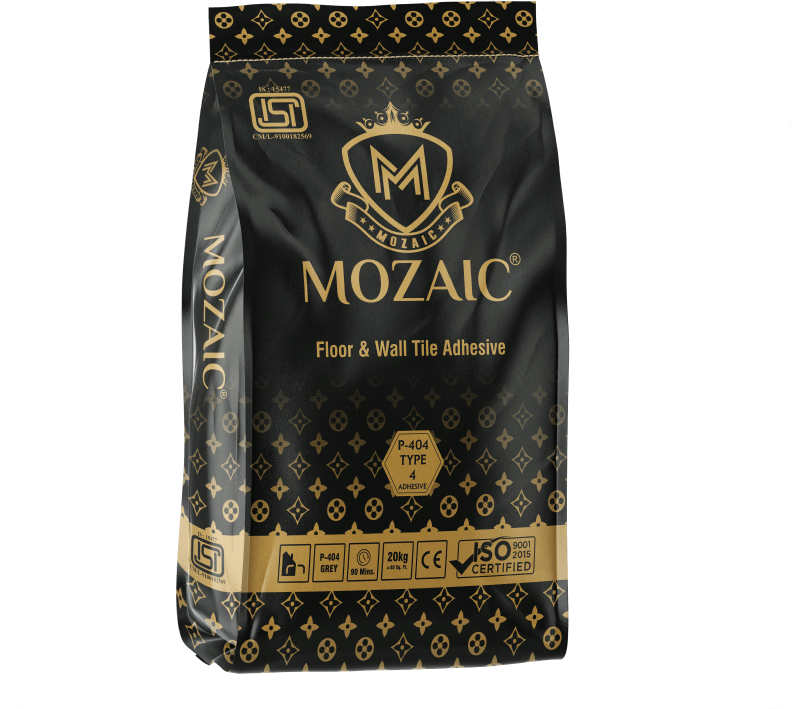
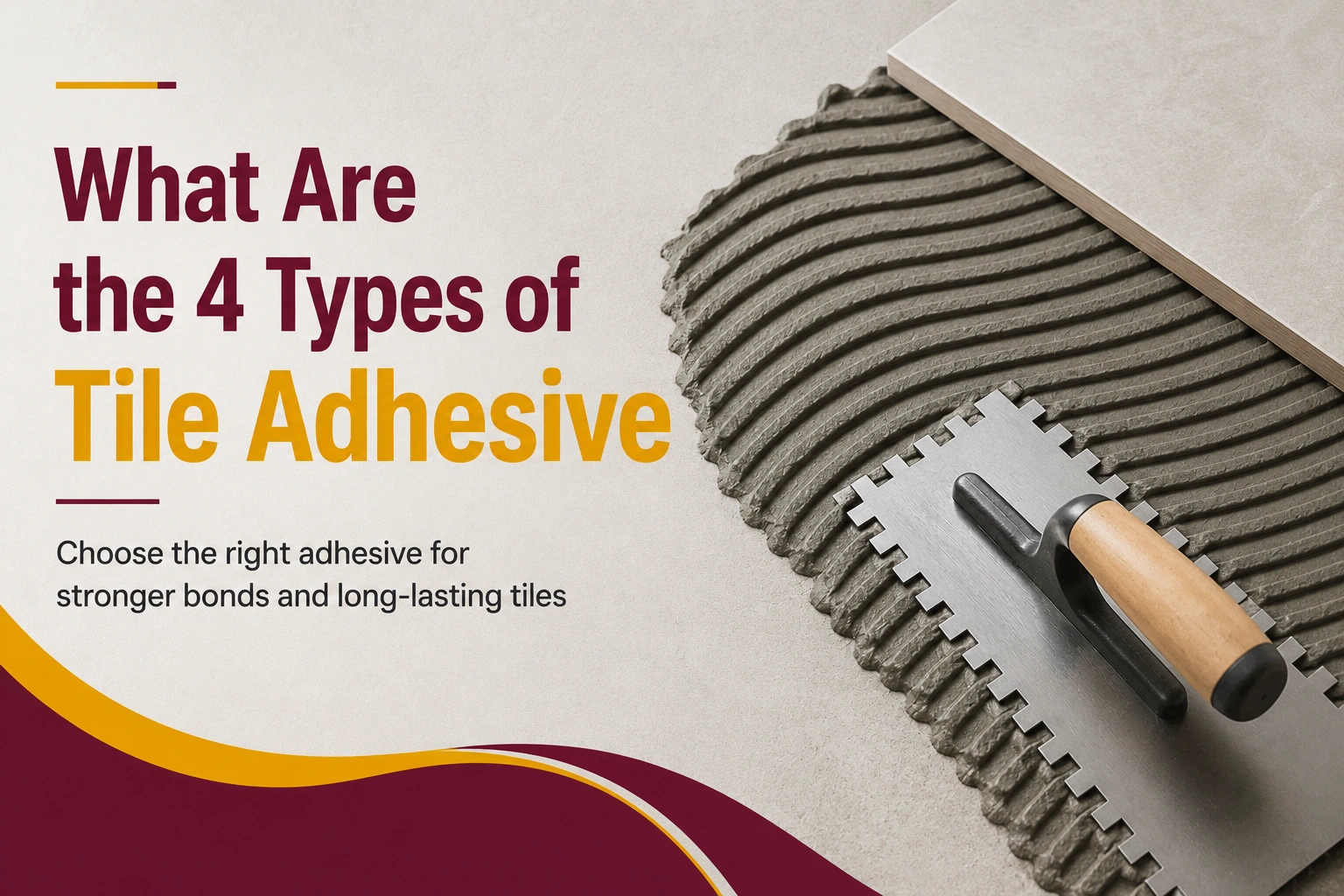
The four common categories of tile adhesive are P-101, P-202, P-303, and P-404, with each formulation designed for specific tile materials, substrates, and installation conditions. As you move from P-101 to P-404, the adhesive offers higher bond strength, greater flexibility, improved water resistance, and suitability for heavier tiles and more demanding applications.
Understanding the Four Types of Tile Adhesive
Modern tile adhesives are formulated using cement, graded silica sand, polymers, and performance-enhancing additives. The four grades—P-101, P-202, P-303, and P-404—help installers select the appropriate adhesive according to tile size, substrate type, traffic conditions, and whether the installation is indoors or outdoors.
Choosing the correct adhesive improves bonding performance, minimises tile failures, and ensures long-term durability.
The 4 Types of Tile Adhesive Explained
P-101 Tile Adhesive
Recommended for:
- Ceramic wall tiles
- Small floor tiles
- Dry indoor areas
P-101 is suitable for standard ceramic tile installations on cement plaster and concrete surfaces. It is commonly used in residential interiors where moisture exposure is minimal.
Typical applications
- Bedrooms
- Living rooms
- Interior walls
- Residential flooring
P-202 Tile Adhesive
Recommended for:
- Ceramic tiles
- Medium-sized vitrified tiles
- Bathrooms
- Kitchens
P-202 provides improved adhesion and water resistance compared to P-101. It is suitable for moderate-moisture areas and supports medium-format floor and wall tiles.
Typical applications
- Kitchens
- Bathrooms
- Utility areas
- Balconies
- Commercial interiors
P-303 Tile Adhesive
Recommended for:
- Large vitrified tiles
- Porcelain tiles
- Tile-on-tile installation
- Exterior walls
P-303 is a high-performance polymer-modified adhesive developed for larger tiles and demanding installations. It provides stronger bonding and greater flexibility, making it suitable for substrates that experience thermal movement.
Typical applications
- Tile over existing tiles
- Exterior façades
- Large-format flooring
- Commercial buildings
P-303 is often paired with epoxy grout for tiles in wet areas and high-traffic environments.
P-404 Tile Adhesive
Recommended for:
- Natural stone
- Heavy porcelain slabs
- Industrial flooring
- Swimming pools
- Infrastructure projects
P-404 is designed for the most demanding tile installations. It delivers maximum bond strength, excellent flexibility, and superior resistance to moisture and environmental stresses.
Typical applications
- Airports
- Hospitals
- Shopping malls
- High-rise buildings
- Industrial facilities
- Luxury residential projects
Tile Adhesive Types Comparison
| Feature | P-101 | P-202 | P-303 | P-404 |
|---|---|---|---|---|
| Bond Strength | Standard | High | Very High | Maximum |
| Ceramic Tiles | ✓ | ✓ | ✓ | ✓ |
| Vitrified Tiles | Limited | ✓ | ✓ | ✓ |
| Porcelain Tiles | No | Limited | ✓ | ✓ |
| Natural Stone | No | Limited | ✓ | ✓ |
| Tile-on-Tile | No | Limited | ✓ | ✓ |
| Interior Applications | ✓ | ✓ | ✓ | ✓ |
| Exterior Applications | No | Limited | ✓ | ✓ |
| Heavy Commercial Areas | No | Moderate | High | Excellent |
| Swimming Pools | No | No | Limited | ✓ |
How to Choose the Right Tile Adhesive?
- P-101 – Standard ceramic tiles in dry indoor areas.
- P-202 – Ceramic and medium vitrified tiles in kitchens and bathrooms.
- P-303 – Large-format vitrified and porcelain tiles, including tile-on-tile applications.
- P-404 – Natural stone, porcelain slabs, industrial flooring, swimming pools, and high-performance commercial projects.
Frequently Asked Questions
1. What is the difference between P-101, P-202, P-303, and P-404 tile adhesive?
The main difference lies in their bonding strength and intended applications. P-101 is suitable for ceramic tiles in dry indoor areas, P-202 works well for vitrified tiles in kitchens and bathrooms, P-303 is designed for large-format and tile-on-tile installations, while P-404 is recommended for heavy porcelain slabs, natural stone, and demanding commercial or exterior projects.
2. Which tile adhesive is best for vitrified tiles?
For most vitrified tile installations, P-202 is suitable for medium-sized tiles in residential spaces. For large-format vitrified tiles or high-traffic commercial areas, P-303 offers higher bond strength and flexibility.
3. Can P-303 tile adhesive be used for tile-on-tile installation?
Yes. P-303 is specifically formulated for tile-on-tile applications when the existing tiles are firmly bonded, clean, and properly prepared. It provides strong adhesion on low-absorption surfaces such as glazed and vitrified tiles.
4. When should I choose P-404 tile adhesive?
Choose P-404 for heavy-duty applications such as porcelain slabs, natural stone, swimming pools, exterior façades, industrial flooring, hospitals, airports, and other projects that require maximum bond strength, flexibility, and water resistance.
5. Is tile adhesive better than using white cement for fixing tiles?
Yes. Modern tile adhesive contains polymers and performance-enhancing additives that provide stronger bonding, improved flexibility, and better durability than white cement for tiles, which is not designed as a tile bonding material.
6. Can the same tile adhesive be used for wall and floor tiles?
Not always. Smaller ceramic wall tiles can often use P-101 or P-202, while larger floor tiles, porcelain tiles, and heavy stone installations generally require P-303 or P-404 to ensure adequate.