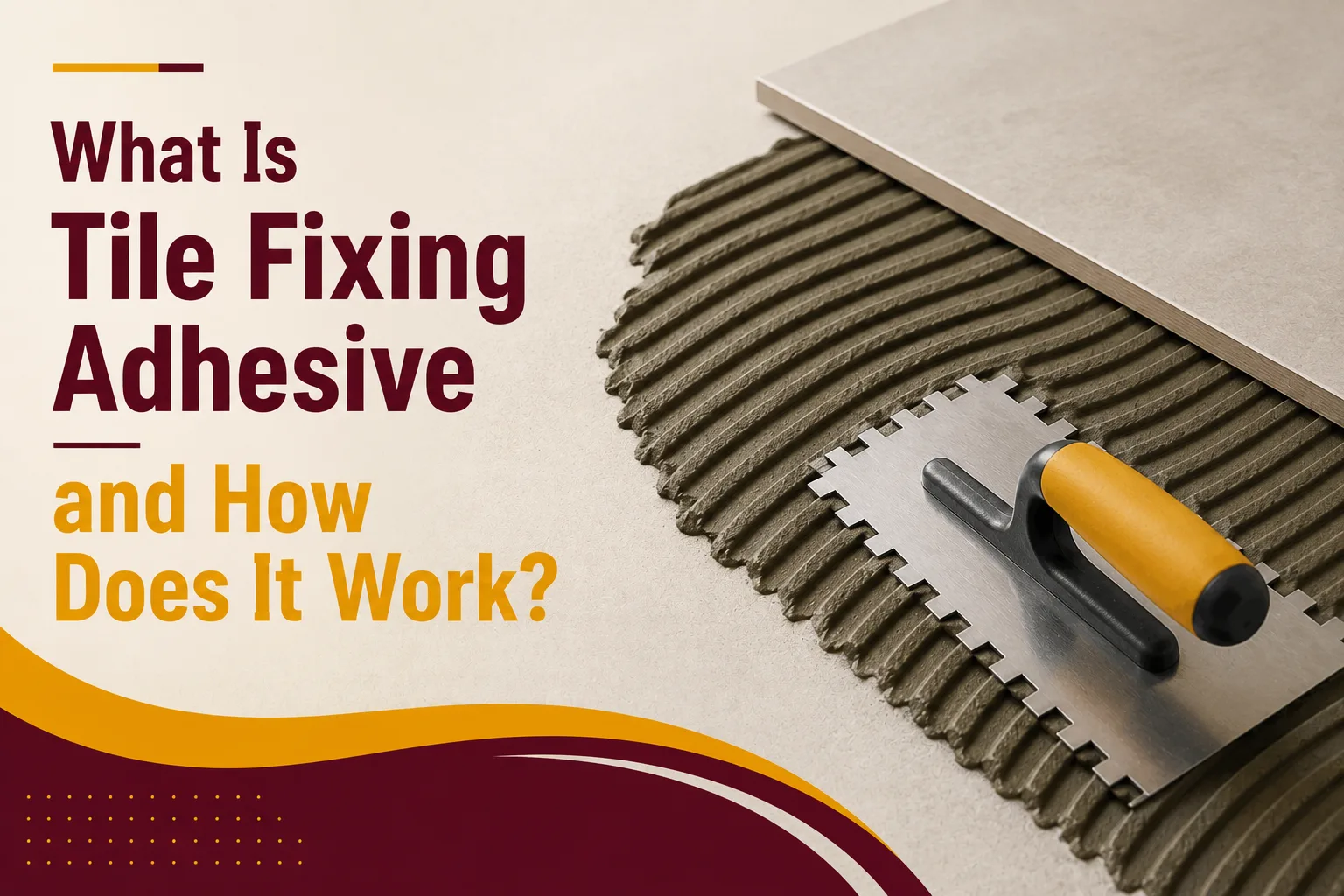
What Is Tile Fixing Adhesive and How Does It Work?

What Is Tile Fixing Adhesive and How Does It Work

Tile fixing adhesive is a specially formulated construction material used to bond tiles securely to floors and walls. It is usually made from cement, graded aggregates, polymers, and chemical additives that improve adhesion, workability, flexibility, and durability. Unlike traditional cement mortar, tile adhesive is engineered for predictable bonding performance with modern tiles.

What Is Tile Fixing Adhesive?

Tile fixing adhesive is a cementitious or polymer-modified adhesive used to fix ceramic, vitrified, porcelain, and other tile materials to suitable substrates. It creates a controlled bonding layer between the tile and surface.

The formulation typically contains cement as the primary binder, carefully graded mineral fillers, and additives that control water retention, open time, slip resistance, and adhesion. Polymer modification can further improve flexibility and bonding, especially where tiles have low water absorption or the substrate experiences movement.

This matters because modern vitrified and porcelain tiles are much less absorbent than many traditional ceramic tiles. A bonding material designed around older tile installation methods may not provide the same performance on these surfaces.

For contractors, the practical benefit is consistency. The adhesive arrives as a formulated product. The installer adds the specified amount of water, mixes it correctly, and applies it using a suitable notched trowel.

How Does Tile Fixing Adhesive Work?

Tile fixing adhesive works by creating a continuous bonding layer between the substrate and the back of the tile. The adhesive grips the surface through mechanical interlocking and, depending on its formulation, chemical and polymer-assisted adhesion.

When mixed with water, cement begins its hydration process. The adhesive gradually develops strength as it cures. Polymer components can improve contact with dense tile surfaces and accommodate limited movement within the installation.

The adhesive must make adequate contact with both surfaces. A strong formulation cannot compensate for a dusty substrate, excessive adhesive thickness, insufficient coverage, or incorrect mixing.

That is why application technique is part of the bonding system.

What Is Tile Fixing Adhesive Made From?

Most cement-based tile fixing adhesives contain four main groups of ingredients:

  • Cement: Provides the hydraulic binding system.
  • Graded aggregates: Control body, consistency, and packing within the adhesive.
  • Polymer additives: Improve adhesion, flexibility, water retention, and workability.
  • Performance additives: Help control open time, slip, setting behaviour, and application characteristics.

The exact formulation varies according to the intended application. An adhesive for small ceramic wall tiles does not necessarily require the same performance characteristics as one intended for large-format porcelain tiles or demanding commercial installations.

How Is Tile Fixing Adhesive Applied?

1. Prepare the substrate

The surface should be sound, clean, dry or appropriately damp as specified by the product, and free from dust, oil, loose particles, and other contaminants.

2. Check the tile

Inspect the tile back for dust, excessive residue, or manufacturing contamination. Dense tiles may require an adhesive formulated specifically for low-absorption surfaces.

3. Mix the adhesive

Add the specified quantity of clean water to the powder. Mix mechanically until a uniform, lump-free consistency is achieved. Avoid adding excess water to make the adhesive easier to spread.

4. Allow the mix to mature

Where the product instructions require it, allow the mixed adhesive to rest for the specified period before remixing. This allows additives to become fully dispersed.

5. Apply with a notched trowel

Spread the adhesive over the substrate and comb it with the appropriate notch size. For larger tiles, back-buttering may also be required to improve coverage.

6. Fix the tile

Press the tile into the fresh adhesive and move it slightly to collapse the ridges. Maintain the specified joint width using suitable spacers.

7. Check coverage

Periodically remove a freshly placed tile and inspect the adhesive transfer. Coverage requirements depend on the application and relevant installation guidance.

8. Allow curing

Protect the installation from premature loading, vibration, water exposure, or other conditions that could interfere with curing. Follow the product’s technical data sheet for usable time and curing requirements.

Also Read: Can Tile Adhesive Be Used for Stone?

Where Is Tile Fixing Adhesive Used?

Tile fixing adhesive is used across residential, commercial, institutional, and infrastructure projects. Common applications include bathrooms, kitchens, living areas, balconies, façades, commercial floors, hospitals, hotels, retail spaces, and industrial facilities.

The correct adhesive depends on more than the tile itself. Tile size, tile absorption, substrate condition, location, moisture exposure, temperature variation, expected traffic, and movement all influence product selection.

For example, a small ceramic wall tile in a dry bedroom presents a very different bonding requirement from a large porcelain tile installed in a high-traffic commercial lobby.

In product selection discussions, terms such as tile adhesive P-101 may refer to a particular product or grade. Always verify the manufacturer’s technical documentation rather than selecting a product solely from its name.

What Is the Difference Between Tile Adhesive and Cement?

Tile adhesive is a formulated bonding product designed specifically for tile installation. Cement is a binder and is not, by itself, a complete tile-fixing system.

Traditional cement mortar can be appropriate for certain construction applications, but modern tiles often require more controlled adhesion. Tile adhesive provides predetermined proportions of binder, aggregates, polymers, and additives.

This also makes application more consistent. The installer does not have to independently determine the proportions of cement, sand, and modifiers for every batch.

What Factors Affect Tile Adhesive Performance?

Five practical factors have a major effect on the final installation:

FactorWhy It Matters
Substrate preparationDust and weak surfaces reduce adhesion
Tile absorptionLow-absorption tiles require appropriate adhesive performance
Tile sizeLarger tiles increase bonding and coverage requirements
Adhesive coverageVoids beneath tiles can create weak points
Mixing and applicationIncorrect water ratios and technique change adhesive behaviour

A useful field check is to periodically lift a freshly installed tile before the adhesive skins over. This shows whether the trowel pattern is transferring properly to the tile back. It is a simple quality-control step that can identify inadequate coverage before the installation becomes permanent.

Can Tile Fixing Adhesive Be Used for Different Tile Types?

Yes, but the adhesive must be selected according to the tile and substrate combination. Ceramic, vitrified, porcelain, natural stone, and large-format tiles can have different absorption rates, weights, and dimensional behaviour.

The same adhesive should not automatically be specified for every project. Contractors should check the manufacturer’s technical data sheet and application recommendations before installation.

For example, Grout should be evaluated according to its manufacturer’s stated application range rather than assuming that one adhesive grade is suitable for every tile and substrate.

Why Does Correct Adhesive Selection Matter?

Incorrect adhesive selection can contribute to tile debonding, cracking, hollow sounds, and premature failure. These problems may appear days after installation or only become visible after months of thermal, moisture, or mechanical stress.

The adhesive is only one part of the system. Proper substrate preparation, correct mixing, suitable trowel selection, adequate coverage, movement joints, and appropriate curing conditions all contribute to installation performance.

For projects involving large tile formats or demanding environments, contractors should involve the manufacturer’s technical team during product selection rather than relying only on price or a generic adhesive label.

Practical Takeaway for Contractors and Project Teams

Tile fixing adhesive is not simply a substitute for cement. It is a formulated bonding system designed around the requirements of modern tile installation.

The right product should be selected by considering the tile, substrate, environment, tile dimensions, and expected service conditions together. Proper preparation and application then allow the adhesive to deliver its intended performance.

Mozaic Chemical’s role as a construction chemicals manufacturer is relevant at this stage because product selection should be supported by technical specifications, application guidance, and project-specific recommendations rather than marketing claims alone.

When the installation also requires joint protection, compatible epoxy grout can be selected according to the area’s moisture, chemical exposure, traffic, and cleaning requirements.

Frequently Asked Questions

What is tile fixing adhesive used for?

Tile fixing adhesive is used to bond tiles to prepared walls and floors. It is available in formulations designed for different tile materials, sizes, substrates, and environmental conditions.

Is tile adhesive stronger than cement?

Tile adhesive is specifically formulated for tile bonding and can provide more controlled adhesion than plain cement. Its performance depends on the adhesive formulation, substrate preparation, tile type, and installation method.

Can tile adhesive be used for vitrified tiles?

Yes. Adhesives can be formulated for vitrified tiles, which generally have low water absorption. The selected product should specifically support the tile and substrate combination being installed.

How thick should tile fixing adhesive be?

The required thickness depends on the adhesive formulation, tile size, substrate flatness, and trowel configuration. Follow the manufacturer’s technical data sheet instead of applying an arbitrary thickness.

Why do tiles come loose after installation?

Common causes include poor substrate preparation, inadequate adhesive coverage, incorrect mixing, unsuitable adhesive selection, excessive open time, substrate movement, and improper curing conditions.

Can tile adhesive be used over existing tiles?

Yes, when the existing tiles are firmly bonded, clean, stable, and suitable for receiving a new installation. The adhesive must be appropriate for the low-absorption surface, and the existing tiles may require additional preparation.

How do I select the right tile fixing adhesive?

Consider the tile material, tile size, substrate, indoor or outdoor location, moisture exposure, expected traffic, and movement conditions. Then select an adhesive whose technical documentation covers those requirements.

Conclusion

Tile fixing adhesive provides a controlled way to bond modern tiles to prepared substrates. Its performance comes from the complete formulation, not from cement alone.

For reliable results, product selection and installation technique must work together. Checking the substrate, choosing the correct adhesive, following the mixing instructions, achieving adequate coverage, and allowing proper curing can significantly reduce avoidable tile-fixing failures.

For technical projects, contractors and project teams should use manufacturer documentation and technical support to verify the adhesive before installation.

Product Details
GENERAL ENQUIRY
contact us form
Social Links

What Is Tile Fixing Adhesive and How Does It Work?

Table of Contents

Tile fixing adhesive is a specially formulated construction material used to bond tiles securely to floors and walls. It is usually made from cement, graded aggregates, polymers, and chemical additives that improve adhesion, workability, flexibility, and durability. Unlike traditional cement mortar, tile adhesive is engineered for predictable bonding performance with modern tiles.

What Is Tile Fixing Adhesive?

Tile fixing adhesive is a cementitious or polymer-modified adhesive used to fix ceramic, vitrified, porcelain, and other tile materials to suitable substrates. It creates a controlled bonding layer between the tile and surface.

The formulation typically contains cement as the primary binder, carefully graded mineral fillers, and additives that control water retention, open time, slip resistance, and adhesion. Polymer modification can further improve flexibility and bonding, especially where tiles have low water absorption or the substrate experiences movement.

This matters because modern vitrified and porcelain tiles are much less absorbent than many traditional ceramic tiles. A bonding material designed around older tile installation methods may not provide the same performance on these surfaces.

For contractors, the practical benefit is consistency. The adhesive arrives as a formulated product. The installer adds the specified amount of water, mixes it correctly, and applies it using a suitable notched trowel.

How Does Tile Fixing Adhesive Work?

Tile fixing adhesive works by creating a continuous bonding layer between the substrate and the back of the tile. The adhesive grips the surface through mechanical interlocking and, depending on its formulation, chemical and polymer-assisted adhesion.

When mixed with water, cement begins its hydration process. The adhesive gradually develops strength as it cures. Polymer components can improve contact with dense tile surfaces and accommodate limited movement within the installation.

The adhesive must make adequate contact with both surfaces. A strong formulation cannot compensate for a dusty substrate, excessive adhesive thickness, insufficient coverage, or incorrect mixing.

That is why application technique is part of the bonding system.

What Is Tile Fixing Adhesive Made From?

Most cement-based tile fixing adhesives contain four main groups of ingredients:

  • Cement: Provides the hydraulic binding system.
  • Graded aggregates: Control body, consistency, and packing within the adhesive.
  • Polymer additives: Improve adhesion, flexibility, water retention, and workability.
  • Performance additives: Help control open time, slip, setting behaviour, and application characteristics.

The exact formulation varies according to the intended application. An adhesive for small ceramic wall tiles does not necessarily require the same performance characteristics as one intended for large-format porcelain tiles or demanding commercial installations.

How Is Tile Fixing Adhesive Applied?

1. Prepare the substrate

The surface should be sound, clean, dry or appropriately damp as specified by the product, and free from dust, oil, loose particles, and other contaminants.

2. Check the tile

Inspect the tile back for dust, excessive residue, or manufacturing contamination. Dense tiles may require an adhesive formulated specifically for low-absorption surfaces.

3. Mix the adhesive

Add the specified quantity of clean water to the powder. Mix mechanically until a uniform, lump-free consistency is achieved. Avoid adding excess water to make the adhesive easier to spread.

4. Allow the mix to mature

Where the product instructions require it, allow the mixed adhesive to rest for the specified period before remixing. This allows additives to become fully dispersed.

5. Apply with a notched trowel

Spread the adhesive over the substrate and comb it with the appropriate notch size. For larger tiles, back-buttering may also be required to improve coverage.

6. Fix the tile

Press the tile into the fresh adhesive and move it slightly to collapse the ridges. Maintain the specified joint width using suitable spacers.

7. Check coverage

Periodically remove a freshly placed tile and inspect the adhesive transfer. Coverage requirements depend on the application and relevant installation guidance.

8. Allow curing

Protect the installation from premature loading, vibration, water exposure, or other conditions that could interfere with curing. Follow the product’s technical data sheet for usable time and curing requirements.

Also Read: Can Tile Adhesive Be Used for Stone?

Where Is Tile Fixing Adhesive Used?

Tile fixing adhesive is used across residential, commercial, institutional, and infrastructure projects. Common applications include bathrooms, kitchens, living areas, balconies, façades, commercial floors, hospitals, hotels, retail spaces, and industrial facilities.

The correct adhesive depends on more than the tile itself. Tile size, tile absorption, substrate condition, location, moisture exposure, temperature variation, expected traffic, and movement all influence product selection.

For example, a small ceramic wall tile in a dry bedroom presents a very different bonding requirement from a large porcelain tile installed in a high-traffic commercial lobby.

In product selection discussions, terms such as tile adhesive P-101 may refer to a particular product or grade. Always verify the manufacturer’s technical documentation rather than selecting a product solely from its name.

What Is the Difference Between Tile Adhesive and Cement?

Tile adhesive is a formulated bonding product designed specifically for tile installation. Cement is a binder and is not, by itself, a complete tile-fixing system.

Traditional cement mortar can be appropriate for certain construction applications, but modern tiles often require more controlled adhesion. Tile adhesive provides predetermined proportions of binder, aggregates, polymers, and additives.

This also makes application more consistent. The installer does not have to independently determine the proportions of cement, sand, and modifiers for every batch.

What Factors Affect Tile Adhesive Performance?

Five practical factors have a major effect on the final installation:

FactorWhy It Matters
Substrate preparationDust and weak surfaces reduce adhesion
Tile absorptionLow-absorption tiles require appropriate adhesive performance
Tile sizeLarger tiles increase bonding and coverage requirements
Adhesive coverageVoids beneath tiles can create weak points
Mixing and applicationIncorrect water ratios and technique change adhesive behaviour

A useful field check is to periodically lift a freshly installed tile before the adhesive skins over. This shows whether the trowel pattern is transferring properly to the tile back. It is a simple quality-control step that can identify inadequate coverage before the installation becomes permanent.

Can Tile Fixing Adhesive Be Used for Different Tile Types?

Yes, but the adhesive must be selected according to the tile and substrate combination. Ceramic, vitrified, porcelain, natural stone, and large-format tiles can have different absorption rates, weights, and dimensional behaviour.

The same adhesive should not automatically be specified for every project. Contractors should check the manufacturer’s technical data sheet and application recommendations before installation.

For example, Grout should be evaluated according to its manufacturer’s stated application range rather than assuming that one adhesive grade is suitable for every tile and substrate.

Why Does Correct Adhesive Selection Matter?

Incorrect adhesive selection can contribute to tile debonding, cracking, hollow sounds, and premature failure. These problems may appear days after installation or only become visible after months of thermal, moisture, or mechanical stress.

The adhesive is only one part of the system. Proper substrate preparation, correct mixing, suitable trowel selection, adequate coverage, movement joints, and appropriate curing conditions all contribute to installation performance.

For projects involving large tile formats or demanding environments, contractors should involve the manufacturer’s technical team during product selection rather than relying only on price or a generic adhesive label.

Practical Takeaway for Contractors and Project Teams

Tile fixing adhesive is not simply a substitute for cement. It is a formulated bonding system designed around the requirements of modern tile installation.

The right product should be selected by considering the tile, substrate, environment, tile dimensions, and expected service conditions together. Proper preparation and application then allow the adhesive to deliver its intended performance.

Mozaic Chemical’s role as a construction chemicals manufacturer is relevant at this stage because product selection should be supported by technical specifications, application guidance, and project-specific recommendations rather than marketing claims alone.

When the installation also requires joint protection, compatible epoxy grout can be selected according to the area’s moisture, chemical exposure, traffic, and cleaning requirements.

Frequently Asked Questions

What is tile fixing adhesive used for?

Tile fixing adhesive is used to bond tiles to prepared walls and floors. It is available in formulations designed for different tile materials, sizes, substrates, and environmental conditions.

Is tile adhesive stronger than cement?

Tile adhesive is specifically formulated for tile bonding and can provide more controlled adhesion than plain cement. Its performance depends on the adhesive formulation, substrate preparation, tile type, and installation method.

Can tile adhesive be used for vitrified tiles?

Yes. Adhesives can be formulated for vitrified tiles, which generally have low water absorption. The selected product should specifically support the tile and substrate combination being installed.

How thick should tile fixing adhesive be?

The required thickness depends on the adhesive formulation, tile size, substrate flatness, and trowel configuration. Follow the manufacturer’s technical data sheet instead of applying an arbitrary thickness.

Why do tiles come loose after installation?

Common causes include poor substrate preparation, inadequate adhesive coverage, incorrect mixing, unsuitable adhesive selection, excessive open time, substrate movement, and improper curing conditions.

Can tile adhesive be used over existing tiles?

Yes, when the existing tiles are firmly bonded, clean, stable, and suitable for receiving a new installation. The adhesive must be appropriate for the low-absorption surface, and the existing tiles may require additional preparation.

How do I select the right tile fixing adhesive?

Consider the tile material, tile size, substrate, indoor or outdoor location, moisture exposure, expected traffic, and movement conditions. Then select an adhesive whose technical documentation covers those requirements.

Conclusion

Tile fixing adhesive provides a controlled way to bond modern tiles to prepared substrates. Its performance comes from the complete formulation, not from cement alone.

For reliable results, product selection and installation technique must work together. Checking the substrate, choosing the correct adhesive, following the mixing instructions, achieving adequate coverage, and allowing proper curing can significantly reduce avoidable tile-fixing failures.

For technical projects, contractors and project teams should use manufacturer documentation and technical support to verify the adhesive before installation.
Blogs