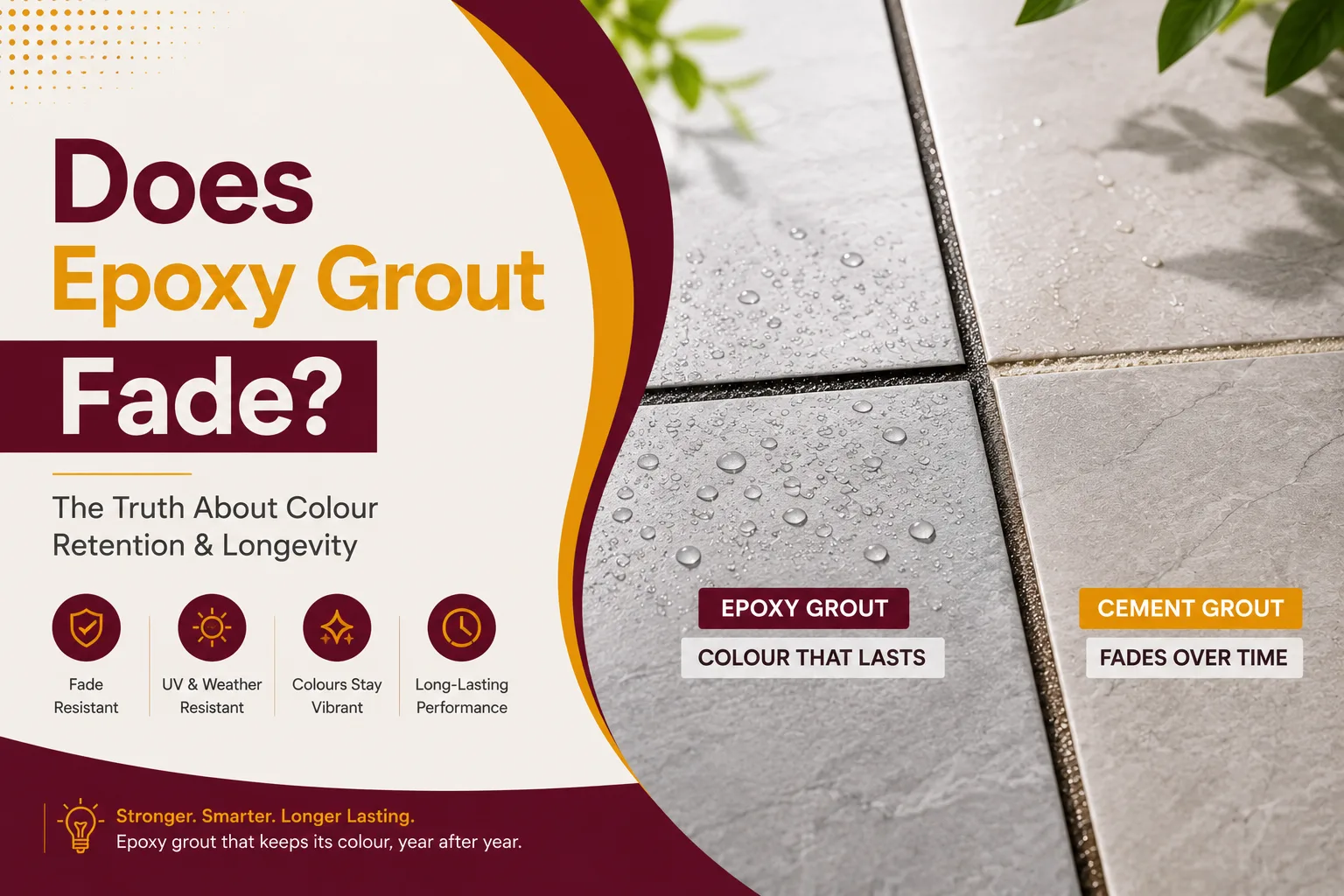
Epoxy grout can experience colour changes over time, but high-quality epoxy grout generally offers excellent colour retention compared with conventional grout. Discolouration can result from UV exposure, improper cleaning, chemical exposure, installation errors, or heavy staining. Choosing quality epoxy grout and following the right maintenance practices can help preserve its colour, finish, and performance for years.
Table of Contents
ToggleWhat Is Epoxy Grout?
Epoxy grout is a resin-based grouting material used to fill the joints between tiles. It combines epoxy resin with hardeners and fillers to create a dense, durable joint.
Unlike conventional cement-based grout, epoxy grout has low porosity and offers strong resistance to stains, moisture, chemicals, and everyday wear.
For example, Mozaic Chemical describes its epoxy grout as suitable for ceramic, glazed tile, and stone applications, with emphasis on colour retention and stain resistance. Its product information also highlights resistance to chemicals and temperature fluctuations.
This makes epoxy grout particularly useful in bathrooms, kitchens, swimming pools, healthcare facilities, cafeterias, and other demanding environments.
Does Epoxy Grout Fade Over Time?
Yes, epoxy grout can change colour under certain conditions, but genuine fading is not always the main reason for a visible colour change.
Epoxy grout is generally more resistant to colour changes than many traditional grout systems. However, prolonged exposure to sunlight, aggressive cleaning chemicals, stains, incorrect installation, and accumulated surface contaminants can affect its appearance.
Therefore, when evaluating epoxy grout fade, it is important to distinguish between actual pigment fading and surface discolouration caused by environmental or maintenance factors.
Why Does Epoxy Grout Fade or Change Colour?
Several factors can affect the appearance of epoxy grout.
1. Prolonged UV Exposure
Direct and continuous sunlight can affect coloured materials over time.
Outdoor floors, balconies, terraces, pool areas, and sun-facing walls experience more UV exposure than indoor surfaces.
If colour stability is important for an exterior application, select a product recommended for the specific environmental conditions.
2. Harsh Cleaning Chemicals
Strong cleaning chemicals can affect grout appearance when they are used incorrectly or at excessive concentrations.
The safest approach is to follow the grout manufacturer’s cleaning recommendations and avoid experimenting with aggressive chemicals.
Mozaic Chemical’s tile cleaner information recommends dilution for routine maintenance and provides application guidance for different cleaning requirements.
3. Staining and Surface Contamination
Sometimes grout appears faded when it is actually covered with:
- Grease
- Soap residue
- Dirt
- Construction residue
- Hard-water deposits
- Cleaning-product residue
This is particularly common in kitchens, bathrooms, commercial kitchens, and high-traffic areas.
4. Incorrect Mixing
Epoxy grout is a two-component or multi-component system that needs accurate preparation.
Incorrect proportions can affect the final appearance and performance.
Always follow the manufacturer’s mixing instructions rather than adding extra resin, hardener, or other materials.
5. Improper Installation
Poor application can leave residue or haze on the tile surface.
If excess epoxy is not removed during the recommended working period, the finished installation may appear uneven or discoloured.
Proper application therefore matters as much as product selection.
6. Temperature and Environmental Conditions
Extreme temperatures and unsuitable site conditions can affect installation and curing.
Mozaic Chemical highlights temperature resilience as one of the properties of its epoxy grout system.
However, installers should still follow the manufacturer’s recommended application conditions.
Epoxy Grout Colour Retention vs Cement Grout
| Feature | Epoxy Grout | Cement-Based Grout |
|---|---|---|
| Colour Retention | Excellent | Moderate |
| Porosity | Low | Higher |
| Stain Resistance | High | Moderate |
| Water Resistance | High | Depends on formulation |
| Chemical Resistance | High | Lower |
| Maintenance | Easier | More frequent |
| Suitable for Wet Areas | Yes | Depends on product |
Epoxy grout is often preferred where appearance, stain resistance, and low maintenance are important.
How to Prevent Epoxy Grout from Fading?
Choose the Right Product
The first step is selecting an epoxy grout suitable for the intended application.
Consider:
- Indoor or outdoor use
- Tile type
- Exposure to chemicals
- Moisture levels
- Traffic levels
- Expected cleaning frequency
For demanding projects, a long-lasting epoxy grout formulated for the application can provide better performance.
Follow the Correct Mixing Ratio
Never estimate component quantities.
Measure and mix according to the manufacturer’s instructions. Consistent mixing helps achieve uniform colour and performance.
Apply Correctly
Prepare the joints properly before application.
Remove dust and contaminants, fill joints uniformly, and remove excess grout from tile surfaces within the recommended working time.
Avoid Aggressive Cleaning
Routine maintenance should use compatible cleaning products.
For example, Mozaic Chemical’s tile cleaner is designed for tile and grout cleaning and provides specific dilution guidance for regular floor maintenance.
How to Maintain Epoxy Grout Colour
A simple maintenance routine can help preserve the original finish.
Daily or Regular Cleaning
Remove loose dust and dirt before it accumulates.
Weekly Cleaning
Clean tiled surfaces using a suitable tile cleaner according to the manufacturer’s instructions.
Periodic Deep Cleaning
High-traffic areas may require more frequent deep cleaning than residential spaces.
Inspect Grout Joints
Check for:
- Discolouration
- Cracks
- Surface damage
- Staining
- Residue
- Joint deterioration
Early intervention can prevent small issues from becoming expensive repairs.
Can You Restore Faded Epoxy Grout?
It depends on the cause.
If the apparent fading results from dirt, soap deposits, or surface residue, professional cleaning may restore much of the original appearance.
However, if the colour has genuinely changed because of prolonged environmental exposure or chemical damage, cleaning alone may not restore the original shade.
Before replacing grout, identify the cause of the colour change.
Where Is Epoxy Grout Most Useful?
Epoxy grout is particularly valuable in areas where moisture, stains, chemicals, or heavy traffic are concerns.
Common applications include:
- Bathrooms
- Kitchens
- Swimming pools
- Hotels
- Hospitals
- Commercial kitchens
- Restaurants
- Industrial areas
- High-traffic flooring
Mozaic Chemical specifically lists applications including swimming pools, fountains, healthcare facilities, kitchens, and other demanding environments.
Complete Tile Installation Matters
Grout performance does not depend on grout alone.
A durable tile installation starts with appropriate substrate preparation and a compatible adhesive system. Choosing the best tile adhesive for the tile and substrate helps provide stable bonding and reduce installation-related problems.
After installation, selecting the right epoxy tile grout can improve joint durability, stain resistance, and maintenance performance.
For floor installations, epoxy grout for floor tiles can be particularly useful in areas exposed to heavy traffic, moisture, or staining.
In addition, the correct tile joint grout application helps create consistent, durable joints between tiles.
Mozaic Chemical: Epoxy Grout Solutions for Modern Projects
Mozaic Chemical provides epoxy grout solutions designed for residential, commercial, and demanding project environments.
Its epoxy grout portfolio focuses on properties such as:
- Stain resistance
- Durability
- Chemical resistance
- Temperature resilience
- Low-porosity performance
- Easy maintenance
- Colour options
Mozaic Chemical states that its epoxy grout is available in different colours and in 1 kg and 5 kg packaging options.
The company also offers tile adhesives, grouts, tile cleaners, admixtures, white cement, and other construction chemical solutions.
Mozaic Chemical’s Industry Presence
Mozaic Chemical is among the established manufacturers and suppliers serving India’s tile installation and construction chemical market.
The company’s product portfolio covers multiple tile installation requirements, allowing builders, architects, contractors, and project managers to source complementary solutions from one manufacturer.
For projects where grout durability, colour retention, and maintenance are important, choosing the correct product according to application conditions is essential.
Expert Recommendation
For the best colour retention and long-term epoxy grout performance:
- Select a product suitable for the application.
- Check whether the area is exposed to direct sunlight.
- Follow the manufacturer’s mixing ratio.
- Prepare joints properly.
- Remove excess grout within the recommended working time.
- Use compatible cleaning products.
- Avoid unnecessarily aggressive chemicals.
- Maintain the surface regularly.
- Investigate discolouration before assuming the grout has permanently faded.
These steps help contractors and facility managers maintain the appearance and performance of tiled surfaces.
Summary
Epoxy grout is designed to provide strong colour retention, stain resistance, and long-term performance, but its appearance can change under certain conditions.
UV exposure, harsh chemicals, staining, improper mixing, poor application, and unsuitable maintenance can all contribute to discolouration.
The best approach is to choose a quality epoxy grout, follow the manufacturer’s application instructions, and establish a suitable maintenance routine from the beginning.
For modern tile installations, Mozaic Chemical provides epoxy grout, tile adhesive, grout, and tile-cleaning solutions designed to support durable and easier-to-maintain surfaces.
Frequently Asked Questions
1. Does epoxy grout fade in sunlight?
Prolonged UV exposure can affect the colour of some epoxy grout systems. For outdoor applications, select a product specifically recommended for the environmental conditions.
2. Why is my epoxy grout changing colour?
Possible causes include UV exposure, staining, cleaning chemicals, incorrect mixing, installation residue, and environmental conditions.
3. Does epoxy grout retain its colour better than cement grout?
Generally, epoxy grout provides better stain resistance and colour retention because of its low-porosity formulation.
4. Can you clean discoloured epoxy grout?
Yes, if the discolouration is caused by dirt, stains, or residue. Use a compatible cleaner and follow the product’s application instructions.
5. Does epoxy grout need sealing?
Generally, properly formulated epoxy grout does not require the same type of sealing routinely associated with porous cement-based grout. Always follow the manufacturer’s recommendations.
6. How can I prevent epoxy grout from changing colour?
Use a suitable product, mix it correctly, apply it according to instructions, avoid harsh chemicals, and maintain the surface regularly.
7. Is epoxy grout suitable for floor tiles?
Yes. Epoxy grout can be used for floor tiles, particularly where stain resistance, moisture resistance, durability, and easy maintenance are important.
8. Is epoxy grout suitable for bathrooms?
Yes. Its low-porosity and moisture-resistant characteristics make epoxy grout suitable for many bathroom applications. Mozaic Chemical also lists bathrooms among applications for its epoxy grout solutions.
Contact Mozaic Chemical
Looking for epoxy grout and complete tile installation solutions?
Call Us: +91 9713200009
WhatsApp Us: +919588704408
Email Us: Info@mozaicchemical.com